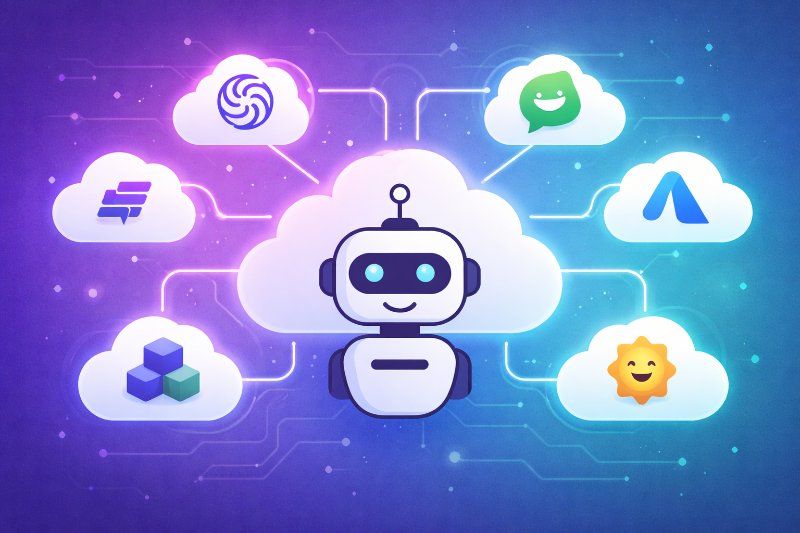
Top 6 AI API Services for Your App and Telegram Bot
Every AI-powered product hits the same moment. Which AI API should we use, really? Not the flashiest demo. The one that survives production. Especially when your app lives inside Telegram and users expect instant replies.
- ➤ Pick for reliability, not hype
- ➤ Design for failures, not best-case
- ➤ Keep the integration replaceable
- ➤ Treat AI like infrastructure
Start With Reality: An AI API Is a Dependency
An AI API is not just an endpoint. It brings pricing rules, rate limits, latency spikes, and odd failure modes. The service you choose shapes your architecture more than your prompt does. If you ship a Telegram bot, those edges show up fast.
- Plan for token costs and unpredictable usage
- Expect timeouts, retries, and partial responses
- Validate outputs like you would any external system
API 1: OpenAI API for Direct Integration
This is where many teams start, for a reason. It is strong for chat, summarization, classification, and internal copilots. It also fits Telegram flows well because streaming makes replies feel instant. Just do not hardcode assumptions about speed or output format.
- ▸ Backend calls the API, never the frontend
- ▸ Prompts stored server-side with versioning
- ▸ Streaming enabled for long responses
- ▸ Output checks for JSON and safety
API 2: OpenRouter as a Model Routing Layer
OpenRouter is not a model provider, it is a switchboard. You get multiple models behind one API. That makes vendor risk easier to manage in real products. It is also handy when different Telegram commands need different models.
- - Your app talks to one endpoint
- - Model choice controlled by config
- - Fallbacks kick in when a model fails
- - Costs can be optimized without rewrites
- - Experiments stay contained and reversible
API 3: Anthropic API for Claude-Style Reasoning
Claude often shines when tone and long-form clarity matter. It can work well for support-style conversations and careful explanations. Teams usually run it on reasoning-heavy tasks, not everything. In Telegram, that can mean escalations, summaries, and tricky user flows.
- 1️⃣ Separate pipeline for complex requests
- 1️⃣ Lower temperature and tighter instructions
- 1️⃣ Strict validation before posting to chat
- 1️⃣ Pair with another provider for resilience
API 4: Azure OpenAI for Enterprise Control
Azure OpenAI is about governance, not novelty. It fits teams that need enterprise networking, compliance, and centralized ops. The models feel familiar, but the environment adds constraints. If your Telegram bot serves corporate users, this can be the safer route.
- ➤ Private networking and enterprise auth
- ➤ Centralized logging and monitoring
- ➤ Policy control and access boundaries
- ➤ Slower setup, steadier operations
API 5: Self-Hosted and Open Models for Advanced Teams
Some teams cannot depend on external APIs. Others need cost control at scale or strict data residency. Self-hosting can be powerful, but it is rarely cheap in engineering time. For a Telegram bot, this usually makes sense only after product-market fit.
- ▸ Dedicated inference service with GPU workers
- ▸ Aggressive caching, batching, and timeouts
- ▸ Clear model upgrade and rollback strategy
- ▸ Strong observability for latency and errors
- ▸ Security review for prompts and stored context
- ▸ Budget for ops, not just hardware
API 6: Hybrid Setups That Mature Apps Use
Most reliable systems do not pick one provider forever. They combine services and add an abstraction layer. It is more work upfront, but it saves you later. When one API degrades, your Telegram bot should still behave calmly.
- Primary provider for most traffic
- Secondary provider for fallback
- Routing layer or internal adapter on top
- Feature flags to switch behavior fast
- Cost guards to prevent runaway spend
- Test harness for regression on prompts
- On-call playbook for outages
How Teams Connect AI APIs Without Breaking Production
The pattern is boring, and that is the point. User requests hit your backend, not the model provider. You assemble context, call the API with strict limits, then validate. If needed, you fall back, and you do it quietly.
- • Rate limiting and retries with jitter
- • Output validation and safe truncation
- • Structured logging for prompts and results
- • Guardrails on tokens, time, and cost
Final Reflection: Build for Change Early
Choosing an AI API is less about models and more about architecture. The best provider is the one you can replace. If your app depends on perfect behavior, it is fragile. If it treats AI as infrastructure, it is resilient.
- ➤ Keep an abstraction layer from day one
- ➤ Track costs like you track uptime
- ➤ Design prompts to be portable