The Gap Between Feedback and Release
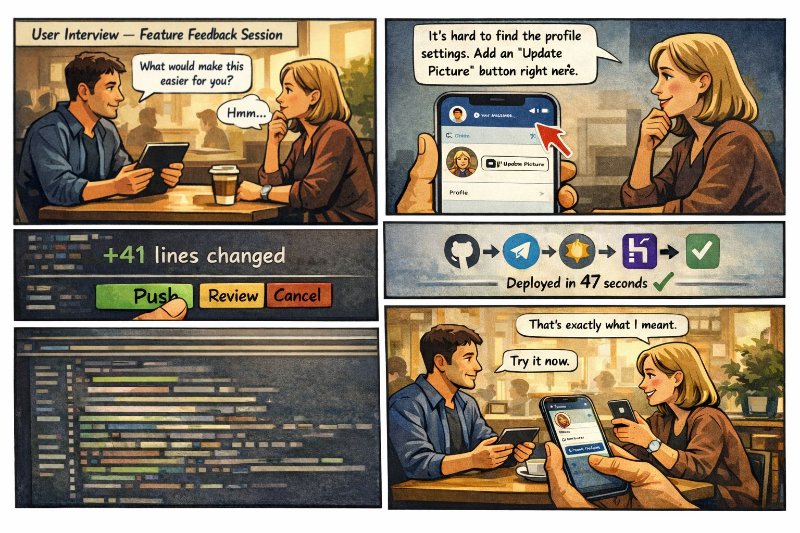
Most product teams still live in two separate worlds: feedback on one side, release on the other. A user asks for something. The PM takes a note. Then backlog, planning, sprint, release. I wanted to compress this cycle.
- ➤ Feedback arrives — but the release is weeks away
- ➤ Context is lost between the request and the implementation
- ➤ Small changes still go through the full ceremony
- ➤ The user has moved on by the time the fix ships
What I Built: A Telegram Bot for AI-Powered Code Deployment
I built a Telegram bot that accepts text or voice messages and turns them into code changes deployed to a live application. For me, this is where AI app development starts to feel real — not as a coding assistant, but as a bridge between user feedback and production software.
- ▸ Send a text command or voice message to the Telegram bot
- ▸ Whisper via OpenRouter converts voice to text
- ▸ Claude receives the instruction along with relevant repository context and returns structured file-level edits
- ▸ The service applies changes to a repository clone, not the running app
- ▸ After confirmation, the bot commits, pushes to GitHub, and Heroku auto-deploys the new version
The Real Product Moment
The most interesting part begins when the feedback is specific enough to be turned into code immediately. Not every request qualifies, but many small changes do — and those are exactly the ones that clog backlogs and frustrate users.
- ➤ UI tweaks: hide fields in advanced settings, rename buttons, change defaults
- ➤ Business logic: limits, whitelists, thresholds, simple validation, access conditions
- ➤ AI bot creation and Telegram scenario adjustments: messages, buttons, permissions, lightweight rules
- ➤ Small internal tools where fast AI workflow automation matters more than perfect dev ceremony
Why This Matters for PMs, Founders, and Small Teams
The main shift is not that AI writes code. The main shift is that the gap between user feedback and production starts to disappear. For PMs, this means less waiting, fewer handoffs, and faster validation of small ideas. For founders, it means you can act on what you learn in user interviews while the insight is still fresh.
- ▸ Less waiting between insight and action
- ▸ Fewer handoffs, less context lost in translation
- ▸ Faster validation of small product hypotheses
- ▸ More experiments per week, not per quarter
Guardrails That Make It Work Safely
Speed without safety is just recklessness. The architecture includes several layers of protection to ensure that fast does not mean careless.
- A. Limit the bot to specific files and directories — not the entire codebase
- B. Force the AI model to return structured JSON, not vague text suggestions
- C. Show a summary and diff preview before every push
- D. Keep deployment inside the standard GitHub to Heroku pipeline
- E. Restrict access to a single admin chat or a very narrow group of people
Where This Breaks in Reality
This setup is powerful, but it is not magic. Unclear feedback still produces bad edits. Weak prompts still lead to weak diffs. And if the repository context is messy, the model can confidently go after the wrong file.
- ➤ Vague requests generate vague code changes
- ➤ Missing or outdated repo context leads to wrong-file edits
- ➤ Complex multi-file refactors are beyond the safe scope
- ➤ The solution is not to slow everything down — it is better guardrails, more precise prompts, and clear rollback procedures
The Big Shift: From AI Code Assistant to Feedback-to-Production Pipeline
I think we are moving from "AI helps the developer write code" to "AI shortens the path between feedback and a live product." This changes how user interviews feel. It changes the speed of experiments. Even the attitude toward the backlog becomes different.
- ▸ This cycle is not needed for every feature
- ▸ But once you feel it on the right use case, there is no going back
Where This Delivers Value Fastest
Not every product or team is ready for this workflow. But there are clear sweet spots where the feedback-to-deploy loop pays off almost immediately.
- I. Internal admin panels and operational tools
- II. Bot products with well-defined scenarios and clear user flows
- III. Early-stage products where speed of iteration beats perfection
- IV. Small teams without dedicated frontend or DevOps resources
What Feels New Here
Not AI as autocomplete. AI as a bridge between user truth and working software. You ship changes while the context is alive. You build product with fewer assumptions and more real-world signal. That is what feels genuinely new — and once you experience it on the right use case, the old cycle feels unnecessarily slow.
- ➤ AI is not just writing code — it is closing the feedback loop
- ➤ The gap between user request and live product is the real bottleneck
- ➤ Telegram bot development combined with AI deployment creates a new product velocity